

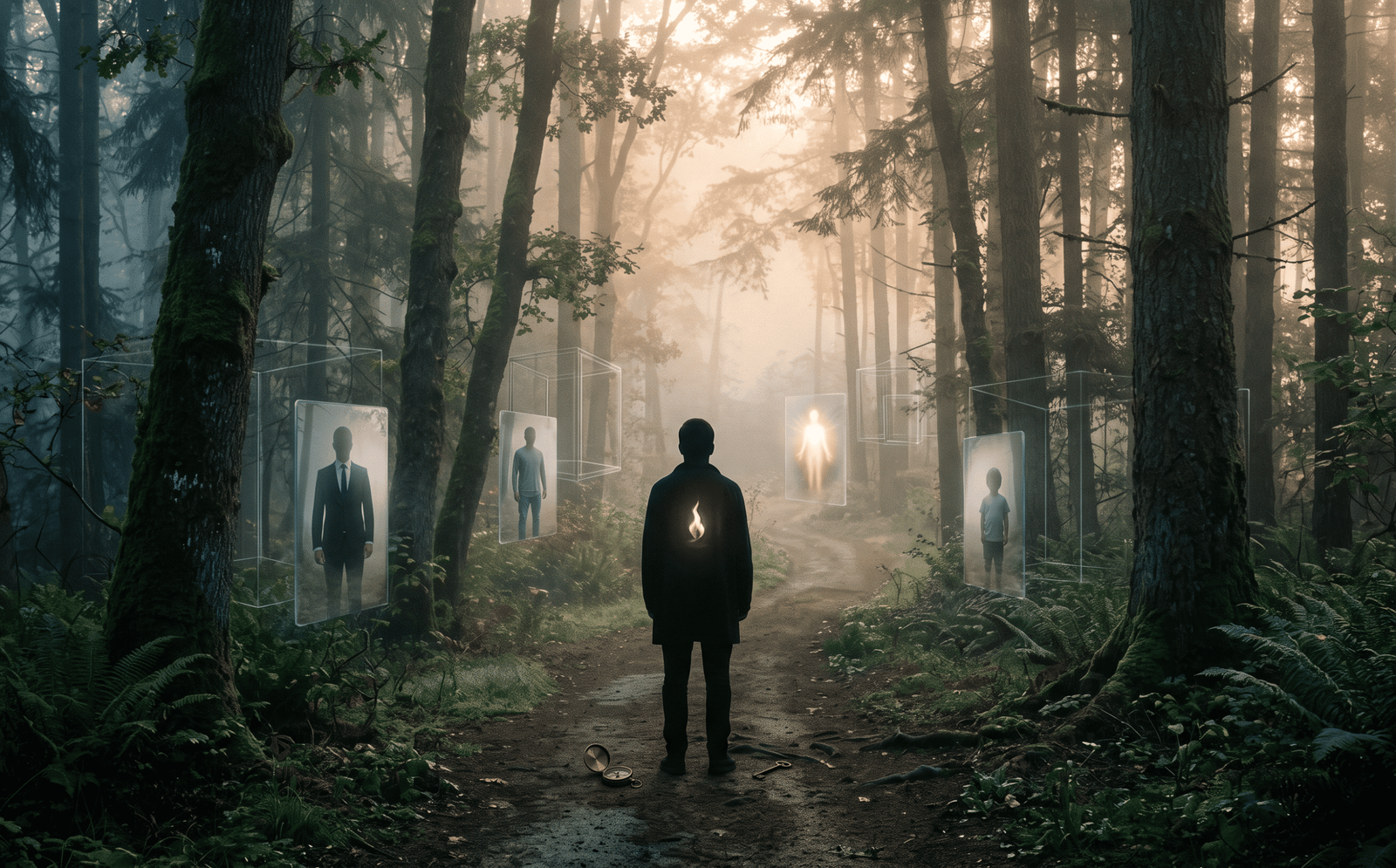
Have you ever paused in the middle of your busy life and quietly asked yourself: “Who am I, really?”
Not the version of you on your résumé. Not the version at work. Not the version your family expects you to be. Not the polished version you show the world.
But the deeper you.
Many of us are very good at living life “properly.” We study, work, earn money, care for others, and try to meet the standards around us. We learn what is considered successful, stable, respectable, and acceptable. But somewhere along the way, a quiet question may appear: “Is this really me?”
You may have a life that looks fine from the outside, yet something inside feels disconnected. You may be doing all the “right” things, but still feel tired, unfulfilled, or unsure why you are walking this path.
This is where self-discovery begins. And perhaps the first step is not to fix yourself or become someone new. Perhaps the first step is simply to return to yourself.
What Does It Mean to Know Yourself?
When people hear “know yourself,” they often think of personality tests, career choices, strengths, weaknesses, or hobbies. These can be helpful, but true self-understanding goes deeper.
To truly know yourself is to gently decode your inner world.
It means exploring your original self — your essence, emotional patterns, values, fears, desires, and inner fire. It means asking why certain things move you deeply, why some situations trigger you, why certain dreams keep returning, and why some choices feel correct on paper but wrong in your heart.
Your true self is not just a label like “introvert,” “creative,” or “practical.” It is a living inner landscape.
It includes questions such as:
- What gives me energy?
- What drains me?
- What do I deeply care about?
- What kind of life feels aligned with me?
- What fears are guiding my decisions?
- What beliefs did I inherit from family, culture, or society?
- What parts of me have I hidden in order to be accepted?
These questions are not always easy to answer. But every honest answer brings you closer to yourself.
Where Does Your Inner Fire Come From?
Every person has an inner fire.
For some, that fire comes from creativity. For others, it comes from connection, freedom, achievement, learning, service, adventure, truth, or love. But many of us spend years chasing a fire that is not truly ours.
We see someone else building a successful business and think, “Maybe I should do that too.” We see friends getting married, buying homes, or climbing the corporate ladder and wonder if we are falling behind. Society praises stability, productivity, wealth, and status, so we begin to believe those must be the only signs of a meaningful life.
But the question is: Is that truly what you want? Or is it simply what you have been taught to want?
A life built around other people’s values may look successful, but still feel empty. You can achieve many things and still feel disconnected if those achievements are not connected to your true self.
Knowing yourself allows you to understand what genuinely motivates you. It helps you identify what lights you up, what makes you feel alive, and what you are only doing out of fear, pressure, or the need for approval.
When you know where your inner fire comes from, you stop copying someone else’s path. You begin to create your own.
The Invisible Frameworks We Live Inside
From the moment we are born, we are shaped by many forces.
Family teaches us what is “safe.” School teaches us what is “successful.” Society teaches us what is “respectable.” Culture teaches us what is “normal.” Work teaches us what is “valuable.”
Some of these lessons are useful. But some become invisible cages.
You may carry beliefs such as:
- “I must always be responsible.”
- “I cannot disappoint people.”
- “I need a stable job to be safe.”
- “I should not take risks.”
- “I must earn a certain amount to be respected.”
- “If I fail, people will judge me.”
- “If I choose differently, my family will not understand.”
These beliefs may feel like truth, but they may actually be inherited frameworks. They may come from fear, upbringing, social pressure, or past experiences.
Self-discovery helps you pause and ask:
Is this belief truly mine? Does it still serve me? Am I choosing this path from love, or from fear? What would I choose if I were not trying to prove myself?
This does not mean rejecting everything you were taught. It means becoming conscious. When you can see the framework, you are no longer trapped inside it unconsciously.
Why Coaching and Counselling Can Help
Self-discovery can happen through journaling, reflection, meditation, life experiences, or meaningful conversations. But sometimes, we need support to go deeper.
This is where coaching and counselling can be powerful.
In a safe and supportive space, you can begin to unpack your thoughts, emotions, beliefs, patterns, and choices. You can explore not only what you do, but why you do it.
For example, you might say:
“I can’t leave my job because that would be irresponsible.”
Through gentle exploration, you may begin to ask:
- What does “responsible” mean to me?
- Who taught me this definition?
- Am I staying because I truly want to, or because I am afraid?
- What financial concerns are real, and what fears are imagined?
- What would a responsible but self-honouring choice look like?
Or perhaps you say:
“I’m afraid to start something new because I might fail.”
Then you may explore:
- What does failure mean to me?
- When did I first learn that failure was dangerous?
- Do I believe failure means I am not good enough?
- What would I do if I saw failure as feedback rather than proof of my worth?
These questions do not force quick answers. Instead, they help you slow down and listen inward. The goal is not to judge yourself. The goal is to understand yourself.
And understanding is often the beginning of healing.
Returning to Your Life Story
One meaningful way to discover yourself is to look back at your life story — not with blame, but with curiosity.
From childhood to this moment, your experiences have shaped you. Some parts of you were encouraged. Some were ignored. Some were celebrated. Some were rejected. Some may have gone quiet in order to survive.
You can ask yourself:
- What did I naturally love as a child?
- When did I feel most free?
- What did people praise me for?
- What did people criticize me for?
- When did I begin hiding parts of myself?
- Which choices in my life were truly mine?
- Which choices were made to avoid judgment or rejection?
As you reflect, you may begin to see patterns.
Maybe you are not “too sensitive”; maybe you learned to notice everything because you had to. Maybe you are not “lazy”; maybe you are uninspired by a life that does not fit you. Maybe you do not lack direction; maybe you have been following directions that were never yours.
This kind of realization can be deeply freeing. When you understand why you are the way you are, you can stop fighting yourself and begin meeting yourself with compassion.
Self-Knowledge Makes Life Feel Lighter
Knowing yourself does not mean life becomes perfect. You will still face responsibilities, financial realities, uncertainty, and other people’s opinions. The difference is that you will no longer be moved only by external pressure.
You will begin to make choices with more awareness.
You will know which compromises are healthy and which ones are costing your soul. You will know which relationships nourish you and which ones require stronger boundaries. You will know what kind of work gives you meaning. You will know when you are acting from fear and when you are acting from truth.
Most importantly, you will begin to trust yourself.
This trust is quiet. It feels like coming home. It feels like being able to say: “I may not have everything figured out, but I am listening to myself now.”
Three Questions to Begin Your Journey
If you feel called to start discovering yourself, begin gently.
- How much of my current life did I consciously choose?
- Which parts feel aligned? Which parts feel inherited, expected, or automatic?
- What am I afraid would happen if I chose differently?
- Would people judge you? Would you lose security? Would you disappoint someone?
- If no one could criticize me, what kind of life would I want to create?
- You may not be able to change everything immediately, but you can begin listening to what your soul is trying to say.
You Are Not Here Just to Fit Into a Frame
You are not here only to meet expectations. You are not here only to follow a timeline. You are not here only to be approved of. You are not here only to survive inside a framework built by others.
You are here to understand yourself, honour your inner fire, and design a life that feels honest, meaningful, and alive.
So if you feel lost, tired, or disconnected, do not rush to blame yourself.
Maybe nothing is wrong with you. Maybe your soul is simply inviting you to return.
Return to your truth. Return to your voice. Return to your essence.
Self-discovery is not a one-time answer. It is a lifelong relationship with yourself. And the more deeply you know yourself, the more gently and courageously you can walk your path.